


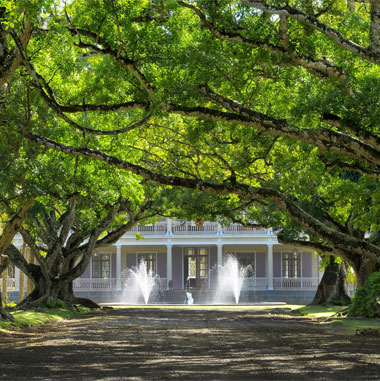
In Mapou, in the northern part of the island, the Labourdonnais Estate tells the story of 19th-century colonial living.
Contrary to what its name might suggest, the château was not the residence of Mahé de La Bourdonnais. The famous Governor of the Mascarenes—builder of modern Port-Louis and a pioneer of sugar cane cultivation on the island—lived between Mon Plaisir (on the site of today’s Pamplemousses Botanical Garden) and Port-Louis. Although Pamplemousses lies just five kilometers from Mapou, there is no direct connection between the Labourdonnais Estate and the French naval officer who arrived on the island (then known as Isle de France) in 1735. Built in 1856 as the main residence of the Wiehe family and beautifully restored in 2006, the estate is steeped in history—a vivid reminder of a colonial era, and today a must-visit highlight of Mauritian tourism.
The architecture of the château is truly remarkable. This colonial building, designed in a Victorian neoclassical style, is constructed primarily from teak wood. Its defining feature is the impressive wraparound veranda that spans two levels. Restoration work took four years, under the supervision of French museologist Claude Fauque and scenographer Alexandre Fruh. Today, a visit to the estate offers a fascinating glimpse into 19th-century lifestyle. From the bedrooms to the living rooms, the attention to detail is striking—and rare, as many traces of this complex colonial past continue to fade away.
Step outside to explore the gardens, the heart of a vast estate surrounded as far as the eye can see by sugar cane fields. From the grand central avenue lined with Indian laurel trees to the centuries-old mango trees, the gardens are simply stunning. Further on, the orchard stretches across 45 hectares, producing fresh juices, fruit pastes, sorbets, and jams—all available on site. Since 2014, the Labourdonnais distillery has been crafting its own rums, aged in oak barrels or infused with flavors such as lemongrass and ginger. The estate has also become a destination for food lovers, with two restaurants on site: La Table du Château, led by Italian chef Fabio, and, set slightly apart, the charming tea room La Terrasse—both highly popular with visitors and locals alike.
It was a beautiful day. The walk may be over, but the story continues.
Practical information: The estate is open daily from 9 a.m. to 3.45 p.m.
 Written with love by Tessa M





Comments